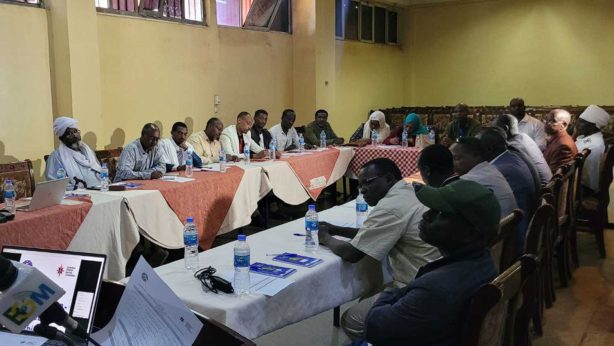
CEHRO and ICTJ cohosted a National Event aimed at enhancing victims’ participation in Ethiopia’s transitional justice process.
Consortium of Ethiopian Human Rights Organizations (CEHRO), and The International Center for Transitional Justice (ICTJ) cohosted a national event to increase victims’ and civil society’s meaningful participation in Ethiopia’s transitional justice process. The event brings together Ethiopian government officials and policymakers, civil society representatives, members of the media, and international stakeholders to discuss strategies to ensure victims and gender-related concerns remain at the center of the efforts underway in the country to deal with recent and past violence and its consequences.
“Transitional justice requires people coming together to address the legacies of cycles of violence, putting victims at the center and their dignity first,” explained ICTJ’s Deputy Executive Director and Director of Programs Anna Myriam Roccatello.
The event concludes a two-year project entitled “Strengthening Civil Societies’ Capacities to Contribute to the Transitional Justice Process in Ethiopia.” Funded by the European Union (EU), the project aimed to equip civil society groups in Oromia and Somali regions with the knowledge and tools to advance victim-centered strategies for redressing past human rights violations and preventing a recurrence of violence.
As part of the project, ICTJ held training sessions and consultations with civil society organizations in the two regions, providing them with technical assistance to improve their capacity to identify and articulate victims’ grievances, reference comparative experiences on transitional justice, and design and implement gender-sensitive advocacy plans to advance victims’ rights. Through these activities, policymakers and university faculty and staff also learned how to develop and effectively execute gender-sensitive approaches.
“The success of the transitional justice process in Ethiopia, however, will depend on the commitment of all stakeholders, from state institutions to victims, civil society groups, and ordinary citizens,” noted CEHRO’s Executive Director Mesud Gebeyehu
As part of the workshop, an art exhibition was held by CEHRO and ICTJ, and awarded artists who score from one to three based on their artwork that reflects their perception and hopes of Transitional Justice in Ethiopia.